Free sample · Cycling to the Arctic
The opening pages of Cycling to the Arctic: The Adventures of a Daring Diabetic, laid out as they appear in the book. Published 28 February 2027. Put the kettle on (and watch what it does to your sugars).
PROLOGUE
BOXING DAY 1994
MY BIRTHDAY
“HAPPY BIRTHDAY AND MANY happy returns,” my mother said. “See! You’re not right about everything!” she added, smugly, and, I imagine, relieved. I knew exactly what she was getting at. She’d likely been waiting to (hopefully) make this call for close to fifteen years! From childhood I’d insisted that I would die at twenty-three and today was my twenty-fourth birthday. I glanced up at the clock as it chimed. I said: “I’m supposed to be dead. Now I’m alive. I’m the luckiest guy in the whole world.” Actually, that was Tony Soprano, episode four of the final series of The Sopranos some years later, but I knew what he meant. Tony had been shot in the pancreas and was lucky to have survived and, as it turns out, my pancreas was shot to shit, too. I had been diagnosed type 1 diabetic aged – Adrian Mole style – 23¾; my body had packed up and if not for an adroit GP on a hot August night and Dr Frederick Banting some seventy years previously producing insulin for injection, then I would indeed be dead. So, to my mind, I had been right, my body packed in
ix
CYCLING TO THE ARCTIC
at twenty-three. Whether I’d seen my own future mapped when a bright young child or that my belief I’d be dead at that tender age somehow created this reality is the subject of a whole other book that I’m happy for somebody else to write, the Dalai Lama perhaps. But if I’d contributed through sheer belief in my own botched demise then it must be possible to cure myself with sheer bloody-mindedness, too, and I haven’t. Not yet anyway.
A few months previously, in the summer of 1994, my then partner, Heather, and I had finished hiking the English Coast to Coast Walk, a long-distance footpath some 190 miles (306km) from St Bees Head in Cumbria on the West Coast, across the Lake District, Yorkshire Dales, and the North York Moors to finish in Robin Hood’s Bay, close to Whitby. For much of the North York Moors leg from Richmond I’d slept fitfully in our tent, getting up regularly to pee, much to the chagrin of Bob, our Border collie and, on this trip, also my pillow. My joints ached and I was continually lethargic. My feet felt like they’d been flogged with a baton much like Brad Davis’s character in Midnight Express. At every brook and stream I’d remove my boots and socks and soak my feet in the cool waters that proffered temporary, blissful respite. One evening we camped at the Lion Inn on Blakey Ridge, a great pub high above Rosedale on the North York Moors and oft one of the first in the area to be cut off in winter, and sometimes you can be lucky enough to be inside when this happens. I’d walked only a few hundred metres the following day, and close to Ralph Cross, the emblem of the North York Moors National Park, I was close to collapse. All strength diminished, I was clammy and disorientated. I struggled to articulate anything but somehow knew my body was craving sugar. A fellow Coaster, Nigel, whom we’d met and befriended on the hills, offered me a piece of Yorkie. I clumsily snatched the whole bar from him, in a way that my memory suggests was somewhat thuggish rather than appreciative, and
x
BOXING DAY 1994 · MY BIRTHDAY
breathlessly devoured the lot, shovelling it into my mouth with trembling hands. Ten minutes and I was good to go again, though Nigel, once owner of a good-sized Yorkie, I think thought me perhaps a tad rude.
I’d suffered a ‘hypo’. A Hypoglycaemic Episode/Attack to give it its proper moniker. Google hypoglycaemia and NHS Inform explains ‘Symptoms usually occur when blood sugar levels fall below four millimoles (mmol) per litre. Typical early warning signs are feeling hungry, trembling or shakiness, and sweating. In more severe cases, you may also feel confused and have difficulty concentrating.’ And what it doesn’t say is rather than feeling slightly hungry, I’d suffer a mighty attack of the munchies, suggesting the body knows exactly what it needs! This had happened once or twice in recent years when I’d put huge effort in on multi-pitch climbs or when digging snow holes to sleep in at the end of long winter days high in the mountains, and I could put this down to simple overexertion and burning more energy than I had consumed. However, we had only just left the Lion Inn, travelled just a few hundred yards and after a well-rested evening, too. This attack, after so little exercise, had been swifter and more aggressive than I’d experienced, previously. Still, I didn’t think too much of it at the time, the Yorkie having worked its magic.
A couple of days later I limped into Robin Hood’s Bay, the end point of the Coast to Coast. I removed my boots and eased my broken feet into the soothing North Sea. I was clearly a type 1 diabetic, I just didn’t know it, yet. The long days of walking would bring my blood glucose levels down to within an almost normal range and the huge calorific intake each evening, usually something high in carbs such as pasta, would elevate my blood sugars and cause fitful sleeping, an insatiable thirst, and a constant need to pee. Then the following day I’d again walk myself ‘better’.
xi
CYCLING TO THE ARCTIC
Once back home the days that followed saw me increasingly drained and run-down. I figured it was simply because I’d just walked quite a distance in under two weeks carrying a huge load – including the dog’s food, as when I clipped Bob’s bespoke panniers on to his lithe, fit body, he simply sat down and refused to move. His full name was Bob Dylan Morris, so a little protest was to be expected, I guess. No longer walking each day there was nothing to bring my blood sugars down and it was impossible to slake my thirst. I couldn’t drink fast enough from a can, so I’d decant to a glass so that I could gulp the full-sugar Tango like a, well, that orange bloke from the adverts who’d just been Tangoed! Of course, I was up peeing all night, but just look at how much I was drinking. Only to be expected, I figured. Plodding on, I returned to work, always weary, always sluggish, but then I’d been up all night peeing. It’ll pass, I thought (pardon the pun).
Another broken night looming, I had returned from the loo, took my glass from the bedside table, took another slug of water, and clambered under the sheets. Heather was a schoolteacher and was good friends with Mandy, the school cook and a larger-than-life character with a huge personality and a meteoric laugh. Whenever Heather started a sentence with, “Mandy said…” I’d wait to hear tell of some hilarity. “Mandy said you might be diabetic,” Heather said. I didn’t sleep that night, either. Mandy, it turns out, is not always such a joker.
I think it was a Monday, I know it was August and a little after 5pm. Heather had made me an appointment with my GP. I told my doc I was run-down, I’d just done a long walk, maybe that’s it, I’d said hopefully. I’m thirsty, tired, drinking all the time, peeing all the time. Yes, I’m irritable but then I’m not sleeping too well, I replied to her pointed questions. She took a small machine from a drawer, the size of a box of Tic Tacs, and slipped a plastic
xii
BOXING DAY 1994 · MY BIRTHDAY
strip into it. She collected something else and with a slight twist, snapped a small plastic cap off it: a lancet, I’d discover, a sharp point glistening under the fluorescent lighting. She loaded it into a trigger mechanism that had five settings for depth, 1 being a fairy kiss and never likely to puncture the skin on the finger of someone that climbs, plays guitar or grafts for a living. She set it to 5, what I would come to call the Ivanhoe setting. Taking my hand, she turned it palm up, thumbed the trigger, and stabbed my finger – Ouch! I still detest this, some thirty years on. Blood instantly sprang as if from a well and formed an apple-pip-sized bead on my fingertip, much like Sleeping Beauty suffered before she fell into a deep sleep. The doc placed the tip of the strip against this small haemorrhage. My modern yet old-fashioned machine takes five seconds now to give a reading but back then it was a very long two minutes. I remember I filled the time telling stories of walking and climbing and generally how super fit I was: an effort to convince my GP that this had to be some horrid mistake, that I couldn’t possibly have a lifelong condition, that my body hadn’t failed me. Nowadays, a sensor is available, permanently latched into the skin and continually barraging your smartphone app with real-time information and guiding your food and insulin intake. I have one now and it’s a game changer, but I didn’t have one for any of the events covered in this book and am still using the old way, but at least only a tiny dot of blood is required rather than the seemingly wilful lancing of a major artery as seemed necessary back in 1994 when I was first diagnosed.
I counted down the last few seconds of the gratingly long two minutes. The meter flashed up a digital read-out: twenty-seven point something. “Is that high?” I had asked. She explained that between four and seven is the target and what is considered the normal range. That’s 4mmol (millimoles) to 7mmol glucose in one litre of blood. So, yes, twenty-seven point anything mmol of
xiii
CYCLING TO THE ARCTIC
glucose in a litre of blood, close to four times the upper amount of what’s considered normal, is indeed high. And like Sleeping Beauty, following this simple finger-prick, my life too wouldn’t be the same again. She (the doc, Sleeping Beauty was sleeping) scrawled a note on headed doctor paper, folded it neatly in half and handed it to me with instructions to present it at the hospital. She would call ahead. They’d be expecting me.
“Just run-down, like I said,” I responded when Heather asked what the doc had said. Later that evening Johnny Dawes, one of the world’s top climbers of the day, had his programme Stone Monkey showing on TV. Known for his incredible dynamic moves where he would launch from tiny finger crimps to similarly tiny grips further up the rock face, momentarily free of any holds and appearing weightless – well, I wasn’t missing that! These were the days before ‘catch up’ and ‘streaming’ and I’d been looking forward to watching it. I figured I’d had this diabetes malarkey a few weeks now, so a few more hours wouldn’t make much difference. I also knew Heather would have an entirely different viewpoint, so I kept shtum, and settled on the sofa with a large glass of water and the remote control. The programme finished – it was great – and as I packed an overnight bag, I explained to Heather what the doc had really said. She was too upset to shout at me. The doc at the hospital wasn’t. He was rather annoyed that it had taken me five hours from diagnosis to make it to the ward. “Where have you been?” he demanded. Had he not chosen medicine, he’d have made a jolly good head teacher. “Watching TV?” he stammered, incredulous. “This is serious!” he scolded, as he led me along a corridor and into a low-lit ward crowded with patients: men and women, elderly and youthful, all equidistant in curtained quads and seemingly all settling down for the night. Curtains were pulled in a hush and nurses and auxiliaries were quietly scurrying, offering care and comfort in vivid contrast to this
xiv
BOXING DAY 1994 · MY BIRTHDAY
pugnacious doctor: “You’re diabetic!” he admonished. “You will be on insulin for the rest of your life!” No further tests, no examinations, just a simple phone call from my GP following the savage attack on the tip of my finger. “Get undressed and get into bed!” he ordered. “I’ll be back soon.” Which I took as an opportunity to sneak out for a quick smoke.
I was soon put to bed and hooked up to drips, machines, and monitors. I would, it seemed, only just drift off to sleep before being woken by a nurse attempting to amputate my fingertips to check my blood glucose levels. The morning would come in the shape of a too-smiley nurse asking how I’d slept. I didn’t return the smile, my humour having deserted me. The following days passed in a blur. I was still on the ward, and nurses were monitoring my blood sugar levels, injecting me, and dictating every morsel that passed my lips. I looked longingly at my neighbours spooning yoghurt or popping grapes into their mouths whilst I was being denied such pleasures “until the doctor says it’s okay.” He was still, it seemed, wearing his head teacher hat and seemed still to be punishing my earlier errant behaviour.
Through expert care ‘my sugars’ (as I came to call my mmol blood glucose levels) were quickly balanced and were being maintained in a steady pattern. Feeling fit and healthy again, with no thirst and fatigue, I was, metaphorically speaking, climbing the walls. I’d had a plethora of healthcare professionals attend me, from dieticians to psychotherapists, all bombarding me with a superfluity of information; I had little time to file one titbit then another would seek to find furrow. My head was fit to burst. Seven healthcare professionals approached and circled my bed, a pincer movement. Planned. Organised. Well executed. To the rear echelon a few student doctors loitered, notepads poised, tapping pencils on teeth (thankfully their
xv
CYCLING TO THE ARCTIC
own) and scrutinising me like an alien oddity. I wanted to go home. I’d been diagnosed, seemingly successfully and with the minimum of fuss, and the wise ones had immediately put me on a restrictive diet whilst plugging me with insulin; ergo, I felt bloody fantastic: the unquenchable thirst was quenched, I wasn’t peeing every five minutes and the lethargy had been euthanised. I felt great other than the being forced to lie in bed, smoke-free.
One of the seven opened a brown paper bag and plucked out a large juicy orange. At last, I thought, something edible rather than something tasteless and apparently made of cardboard! Another pulled out a sleek syringe with a long, fine needle jutting from its tip. Plunging the needle into the orange, she proceeded to draw juice into the neck of the syringe before holding it aloft, flicking it twice with a manicured nail and expelling the air with a gentle twitch of the plunger. Turning her attention to me, she arched an eyebrow in what appeared a very sinister way and said, “Your turn.” A very swift training session and then it really was my turn. I had to stick a needle into my skin. Directly into my stomach. I faltered. It was as if a magnetic force was repelling the tip, holding it an inch or so from my flesh.
“Come on. We all have to inject ourselves as part of our training,” said one. “It’s easy,” said another.
I wondered, if it was so easy, why it took seven of them and a bag of oranges to show me how to do it, and I said so.
“Diabetes is a very serious condition,” continued another. “You can’t leave until we know you can inject yourself.” I was desperate to get out of hospital, so it was all the impetus I needed, and I plunged the fine metal point into my belly. I was really rather chuffed with myself. The Magnificent Seven and their apprentice cohort appeared somewhat less awed. Diabetes is indeed a serious condition, more so than I’d accredit it for several years. Though I’m happy to say it has never stopped me doing anything. Absolutely nothing at all, some of which
xvi
BOXING DAY 1994 · MY BIRTHDAY
you’ll discover if you haven’t put this book down yet, and some of which I had planned for the very next day, once free of the cloistered ward.
I was shown how to use my insulins, one a fast-acting ‘daytime’ insulin to be taken with meals, the other a long-acting one, to be taken before bed each night, always at the same time; 10pm was the suggestion (which I thought, correctly as it happens, was never going to happen!). Presently, I was ready to be discharged and just needed a final nod from the doc.
“Very good,” he said, when his rounds eventually brought the white-coated Pied Piper to my bed, stalked by his eager protégés. He reiterated the importance of controlling my blood sugar, of a healthy diet and regular exercise, still every inch the head teacher.
“Now do you have any questions before you’re discharged?” he asked.
With a headful of answers to questions I hadn’t even asked I looked to find a gap to plug. I asked at what temperature insulin would freeze. Ha, that flummoxed him. He glanced around at his disciples. Feet shuffled, eyes glanced down, heads half turned. One student looked like she might have known the exact temperature on the Kelvin scale but either lacked the confidence or couldn’t stop tapping her teeth to speak before the doc said, “Why do you want to know that?” I explained that I spend a lot of time in snow holes on mountains in severe winter conditions. One time I had been on the Black Cuillin on the Isle of Skye for three nights sleeping in a hollow under a boulder and the sausage we’d taken up to cook hadn’t thawed in seventy hours and it had been spooning Andy in the bottom of his sleeping bag for the past two nights! I didn’t need to be cooking some such breakfast sausage to find my insulin was a useless stalactite.
“You’re a climber?” In a tone that suggested he clearly
xvii
CYCLING TO THE ARCTIC
wasn’t. “Don’t climb for now, not yet.” A pause. “Until you’re used to it all,” he added. In my hefty new diabetes filing cabinet, yet to be Dewey decimalised, alphabetised, numerised or any other sort of ‘ised’, I scrabbled for a riposte. Exercise, I had been told, was good and would impact my blood glucose readings positively – something I knew well from my recent trek across the north of England.
“How long do you suggest?” Being polite. Feigning interest. Buying time.
“Oh, not too long,” he replied. “Say six months.” And with a straight face, too!
Physical activity and mental health both have a huge impact on blood sugar levels – and I knew this because every healthcare professional had taken great strides in recent days to drum this message home. So not to climb for six months would have my body getting used to a lifestyle I had no intention of pursuing. I’d just have to recalibrate all over again in six months, surely.
“I’ll take that under advisement,” I answered. I thanked them all and collected my clothes and a hold-all full of meds and left. I took the orange, too.
The following morning was bright with a soft breeze and a warming sun. Perfect for climbing. I took my chalk bag and rock boots up to Highcliffe Nab, a short walk from my home in Guisborough. It being a normal workday, all my climbing buddies were unavailable. I had little option but to solo free climb – unless I opted for not climbing, which I couldn’t and wouldn’t do! In fairness, free climbing solo wasn’t an unusual occurrence; my chalk bag and stickies (aka rock climbing shoes) spent whole summers in the back of the car and an early mark from work on a bright evening would see me head to Scugdale in the Cleveland Hills (much like some folk go to the gym after work) and I’d tick off some rich but short south-facing routes
xviii
BOXING DAY 1994 · MY BIRTHDAY
cosseted by a dipping sun. I had in fact soloed the arête of Guisborough Maternity Hospital a couple of years before, to visit Heather and my day-old daughter, Kyrie. In the exhilaration of the responsibilities of being a father I’d left Heather’s orange juice in the car. The hospital was an old building built in the aftermath of WWII and it had sturdy holds morticed into the brickwork – and a sturdy matron that slammed the heavy aged wooden doors behind me with a clanking rebuff at the end of visiting time. Heather appeared at the sash window on the top floor high above, leaned out and asked, “Wherefore art my orange juice?” Or something similar. “Hang on,” I answered and climbed the arête of the building and stretched to hand her the bottle. I was severely chastised as she reached across to take the bottle. In the exhilaration of climbing a building, I’d seemingly already forgotten about the responsibilities of being a father! That first summer, I’d swing by home after work to collect Kyrie and take her up to Scugdale with me, leaving her swinging in her car seat slung from an overhanging crag whilst I free soloed, popping back between routes to give her a not-so-gentle shove, the responsibility thing still giving me a bit of a swerve. Kyrie is grown now (somehow), listens to Bob Dylan, wears her hair like Bob Marley and lives on a canal boat, which obviously I believe is all down to me. So does her mother, I think, though with less enthusiasm.
So, everyone being at work and me being no stranger to climbing free and solo is what led me to be standing, at 9am the morning after my discharge from hospital, at the base of a twenty-one-metre HVS (Hard Very Severe) 5a, twisting up a lovely line of sandstone on Highcliffe Nab, North Yorkshire. Alone but for my stickies, my chalk bag, and my dog. Bob wore an air of disinterest, oblivious that this day was… different.
It being so close to home, I was a regular at Highcliffe. But this day was very different. I had to consider more than just the
xix
CYCLING TO THE ARCTIC
wind, the friction, the quality of the holds and their potential grunginess on this north-facing route. I had a whole new set of internal factors to consider, too. I was twenty-three but no longer immortal in that stubborn youthful way that the young often think. It was a slow dawning that had to be accepted quickly. I had to pay attention to my body. How the hell do I do that? Easy. Ignore it, I decided. I stretched off and took my place at the foot of the climb. I dipped my fingers into my chalk bag and dusted my feet on my calves. I stepped upwards. Yes! It felt great! I’d sauntered up the route enough times to know where the holds and cracks lay, and I knew it to be a beautiful and flowing climb, tricky in a ballet move rather than a power lifter kind of way. As I began to meld into each flowing movement, I became increasingly aware of less and less. For a fleeting moment I was a climber and only that, me and the rock, face dancing. I pulled easily up on to a generous ledge and turned to look across the top of the trees upon the rat race far below. I laughed at the doctor holed up doing his rounds, spouting advice of what not to do and how not to do it and how long to not do it for.
Dabbing again into my chalk, I turned back to the wind-hewn sandstone. I reached with my left hand for a hold I knew to be secure, placed my right hand above and… froze! The next move was a layback. What if my sugar was to drop? I’d be weakened… I’d catapult off… I can’t easily step back down from a layback. It’s a committed move. Shit. I can’t down climb. Nothing to do with pride; I simply can’t down climb. Never been very confident with it. Up. That was all I could do. Go up. Or stay! Shit! Shit! Shit!
My palms were sweating. I fumbled for chalk. I dusted my feet, breathing deeply, faltering. Panic. More chalk. Dusted my feet again. Chalk. Shit. Breathe. “Get a grip!” Literally! I cursed myself, a venomous scolding whisper. I never did
xx
BOXING DAY 1994 · MY BIRTHDAY
regain full control. I never did knowingly focus. I just climbed. And then I was at the top. I ran and stumbled and bounced down the bankside to the rear of the crag. Soon after, I was at the foot of the route again. Right. You’re mine! Breathe! And I climbed it. Just once more and this time without a break. Atop and again a look in the direction of James Cook University Hospital a few miles to the north and a gentle nudge to the west. I’d climbed it. Faultlessly. But now as a mortal. A frightened, excited mortal. “Look, Ma, top of the world!” I bellowed, James Cagney style. Taking a huge, gleeful breath, I looked all about me: Guisborough, the Ancient Capital of Cleveland, seemingly silent and sullen below. Middlesbrough beyond. Ormesby Bank arcing down in the direction of the industry which is now mostly listless along the snaking River Tees. The majestic moors stretching around me and ablaze with purple heather rippling in the breeze. A cliché, I know, but the only place I never looked was back. The six months hiatus prescribed was abandoned inside twenty-four hours. I may have diabetes, Doc. But I’m not a diabetic! An angry mantra I would sustain for many years, close to twenty-five, in fact, and with many more adventures behind me, too.
Years later, another doc would pull me aside, more mellow, more head of year than head teacher. “If you don’t start to look after yourself, you’ll go blind. You could end up losing a leg,” he warned, not unkindly. I’d had lasers to cauterise bleeds in my eyes that threatened my vision. Your eyes are home to some of the tiniest blood vessels in your body and as such they’re amongst the weakest. High blood glucose levels over many years is akin to pumping red treacle through your veins rather than healthy, oxygenated blood that a healthy functioning body, with a working pancreas, does – with just the miraculously correct levels of glucose to enable proper function… Well, it’s
xxi
CYCLING TO THE ARCTIC
bound to have a detrimental effect eventually. Couple this with a diagnosis of COPD (chronic obstructive pulmonary disease) and a few years after I had at last stopped smoking, too – and I’m not the fit young thing described in just a few pages back. I’ll not linger too much over the COPD as, unlike my type 1 diabetes, it was wholly self-inflicted in my teenaged pursuance of looking cool and smelling horrid. I was in my late thirties before finally kicking the habit and around forty-three when a doc had announced I had the lungs of a seventy-three-year-old, ignoring my question as to whether it was a healthy seventy-three-year-old, or not. After all, my uncle Arthur had died of lung cancer at seventy-three, whereas I reckon Sir Roger Bannister was at that age, still doing laps of the park; I didn’t think the question as ridiculous as he clearly did. I now always carry an inhaler in one pocket to counterbalance the insulin pen in the other. Second-hand smoke (vapes, too) causes my lungs to contract like a Venus flytrap and a short hill climb on my bicycle would often have me gasping and coughing myself sick once I’d topped out reaching for my inhaler and water bottle. I’d stupidly pride myself on never getting off the bike but would suffer this bout of coughing and puking whilst steadily pedalling on.
Even with all this said, I knew I wasn’t going to start looking after myself in any real meaningful way. I wasn’t going to start setting alarm clocks to go off mid-morning signifying I could now have a cup of tea with a careful measure of semi-skimmed milk, like an ex-colleague used to do, refusing all and any other offers of a beverage unless the clock said it was okay. I thought this ridiculous, tedious, and unnecessary. Attention-seeking, even. Now I have my sensor continually monitoring my glucose levels on a line chart, I can appreciate the effect a brew can have: my line can show a steady undulation throughout the night, nicely within range (marked in green), and twenty minutes after my morning cuppa, the graph will surge like it’s attempting
xxii
BOXING DAY 1994 · MY BIRTHDAY
an ascent of the north face of the Eiger! But knowing hasn’t altered anything – other than perhaps an appreciation of my ex-colleague’s efforts!
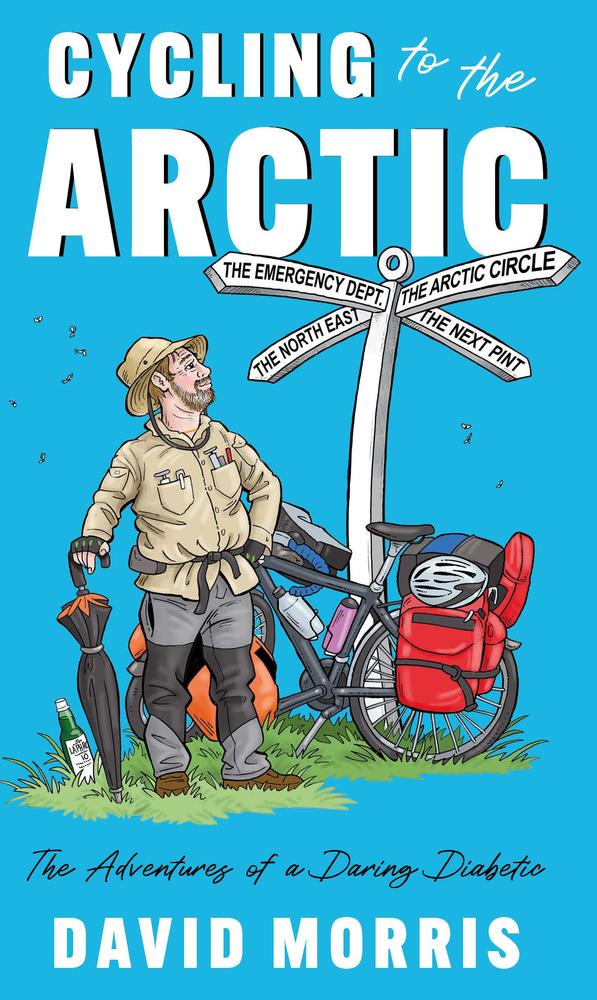
Knowing I’m unlikely to look after myself in any meaningful way – other than never again smoking a cigarette – and certainly not likely to start drinking tea on a schedule, I figured I had at least one more adventure in me whilst I still had eyes to see and legs to pedal. This is how, in part at least, I found myself on a ferry to Amsterdam with a fully loaded bicycle and a target of cycling to the Arctic Circle.
xxiii
Want to know what happens next?
Twenty-five years after that climb, a ferry to Amsterdam, a fully loaded bicycle and a target pinned to the map: the Arctic Circle. Cycling to the Arctic is out on 28 February 2027 in paperback (£12.99) and ebook.
Also from Waterstones, Blackwell’s and Amazon. Extract © David Morris.

